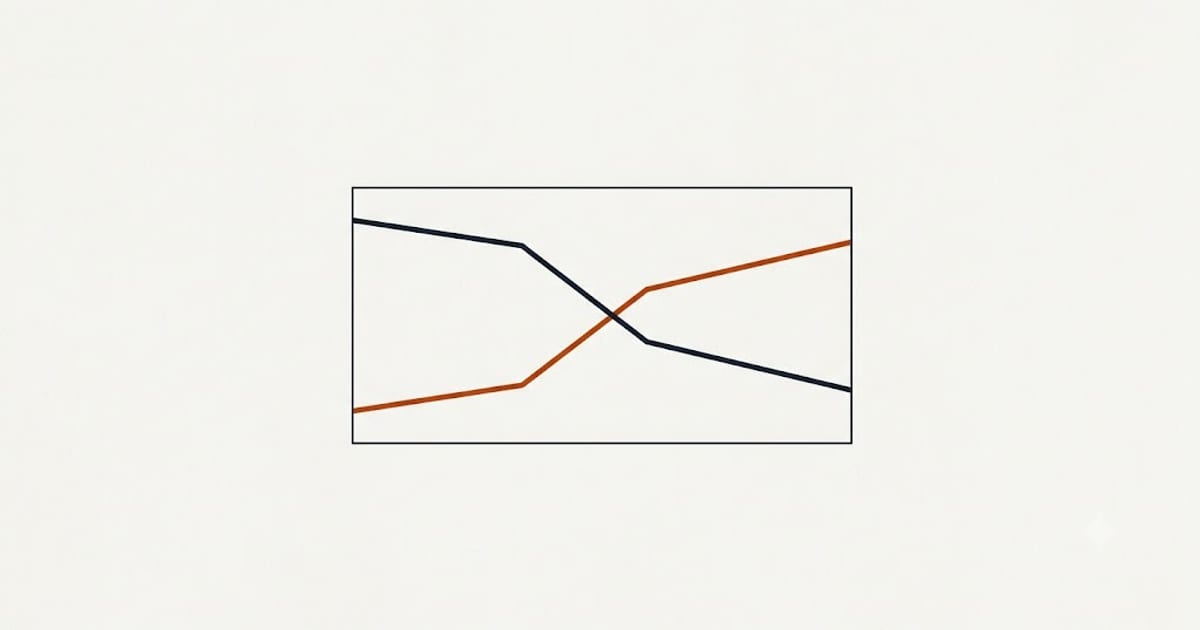
On a $400,000 mortgage at 6.5% over 30 years, the monthly payment is about $2,528. Of the first payment, roughly $2,167 is interest and about $361 is principal.
That is not a trick and nothing is being front-loaded against you. Interest is charged on the balance outstanding, and in month one the balance is the whole loan.
The arithmetic
Each month, interest is the balance times the monthly rate. At 6.5% annually the monthly rate is 6.5% ÷ 12 = 0.5417%.
Month one: $400,000 × 0.005417 = $2,167 interest. The payment is $2,528, so $361 reduces the balance.
Month two: the balance is $399,639, so interest is $2,165 — two dollars less — and $363 goes to principal.
The payment never changes. What changes is the split, and it moves by a couple of dollars a month at first. That slowness is why the early years feel like standing still.
Where the crossover happens
The point where more than half the payment goes to principal depends on the rate and the term, and it is later than most people expect.
At 6.5% over 30 years, the crossover arrives around year 18. At 4% it comes near year 13. At 8%, near year 22.
Higher rates push the crossover later, which is the same fact as saying more of the total cost is interest.
What the total looks like
That $400,000 at 6.5% over 30 years repays about $910,000 in total — roughly $510,000 of interest, more than the amount borrowed.
The same loan over 15 years carries a payment of about $3,484, and total interest of about $227,000. Paying $956 more each month saves roughly $283,000.
Why one extra payment a year does so much
Any extra amount goes entirely to principal, and every dollar of principal removed stops accruing interest for the whole remaining term.
An extra $2,528 once a year on that loan — one additional monthly payment — takes roughly five to six years off the schedule and saves in the region of $130,000.
The mechanism is not that the extra payment is large. It is that early principal has the longest time left to compound.
Where extra payments count most
The earlier the better, and the effect is dramatic at the front end.
An extra $10,000 paid in year one removes $10,000 of principal that would otherwise have accrued interest for 29 more years. The same $10,000 in year 25 saves only five years of interest on that amount.
If you expect to make extra payments at all, making them early is worth far more than making them regularly.
Two things to get right
Tell the servicer it is principal-only. Extra money sent without instruction is frequently applied to the next month's payment instead, which advances the due date and saves nothing. Most servicers have a specific field or option for it.
Check for a prepayment penalty. Rare on modern conforming mortgages, more common on subprime and on some car loans, and worth confirming before making a large payment.
Biweekly plans
Paying half the monthly amount every two weeks produces 26 half-payments a year, which is 13 monthly payments rather than 12.
That is the entire mechanism: one extra payment a year, arriving as a schedule rather than a lump sum. Companies charging a setup fee to arrange it are selling something you can do yourself by dividing your payment by twelve and adding it each month.
Recasting and refinancing are not the same
Recasting keeps your rate and term but recalculates the payment on a reduced balance after a lump sum. It lowers the monthly payment and usually costs a few hundred dollars.
Refinancing replaces the loan entirely, at whatever rate is available now, with full closing costs.
If you have received a windfall and your rate is already good, recasting is normally the cheaper move — and many borrowers do not know it is available because servicers rarely mention it.